

If this has just happened
If you have injured your knee and cannot straighten it, cannot lift your leg off the bed with the knee straight, cannot bear weight, or the knee looks deformed, go to an emergency department.
These injuries need imaging and assessment without delay. Tendon ruptures in particular give better results when repaired early, and a delay of weeks makes the repair considerably more difficult.
This page explains the injuries and their treatment. It is not a substitute for urgent assessment.
What injuries does this cover?
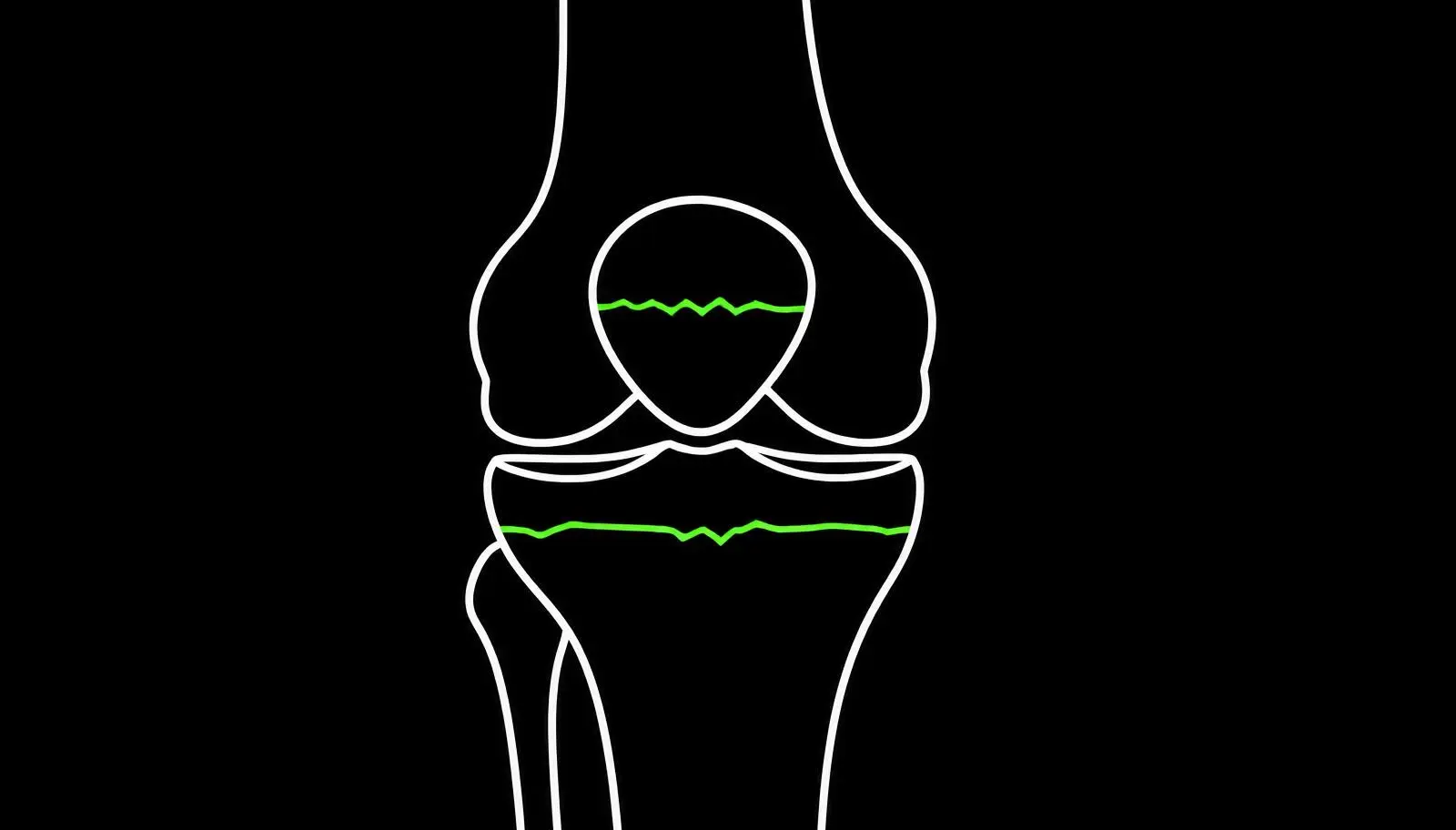
Several different injuries around the knee are grouped here because they share a common feature. Each one interrupts the mechanism that straightens the leg, or damages the bone that mechanism depends on.
Patellar fracture
A break in the kneecap, usually from a direct blow, such as a fall onto the front of the knee or a dashboard injury in a road traffic collision. If the fragments have separated, the extensor mechanism is disrupted and you will be unable to straighten the knee against gravity.
Distal femoral fracture
A break in the lower end of the thigh bone, just above the knee. In younger people this is usually a high-energy injury. In older people it can follow a simple fall, particularly where the bone is weakened. It also occurs around a knee replacement, which is known as a periprosthetic fracture and requires specific expertise.
Tibial plateau fracture
A break in the upper surface of the shin bone, at the point where it forms the lower half of the knee joint. Because the fracture involves the joint surface itself, restoring that surface accurately matters a great deal for the long-term condition of the knee.
Quadriceps tendon rupture
The tendon above the kneecap, connecting the thigh muscles to the patella, tears completely. Typically occurs in people over forty, often when the knee gives way or during an awkward loaded movement. There is usually a sudden pain, a sensation of something giving, and an inability to straighten the knee or climb stairs.
Patellar tendon rupture
The tendon below the kneecap tears. More common in people under forty, often during sport or a jumping or landing movement. The kneecap may sit noticeably higher than normal.
Tibial tubercle avulsion
The bony attachment of the patellar tendon on the shin bone pulls away. Most often seen in adolescents during jumping sports.
How are these injuries diagnosed?
Assessment begins with what happened and what you can and cannot do. The key question is whether you can actively straighten the knee, or lift the leg straight while lying down. Being unable to do so suggests the extensor mechanism is disrupted, whatever the cause.
X-rays identify most fractures and can show a kneecap sitting abnormally high or low, which points to a tendon rupture.
CT scanning is often used for fractures involving the joint surface, giving detailed information for planning surgery.
MRI shows tendons and soft tissues, and is used where a tendon rupture is suspected but the picture is not clear.
Where an injury has occurred around an existing knee replacement, the previous surgical records and implant details are important and should be obtained.
How are these injuries treated?
When surgery is needed
Most of these injuries are treated surgically. Surgery is generally required when:
- The extensor mechanism is disrupted, so the knee cannot be straightened actively
- Fracture fragments have separated
- The fracture involves the joint surface and the surface is no longer even
- The knee is unstable
- A tendon has ruptured completely
- The fracture is around a knee replacement and the implant is affected
When it may not be
Some injuries can be treated without an operation. An undisplaced patellar fracture, where the fragments remain in position and you can still straighten the knee, may be treated in a brace or cast. A partial tendon tear where straightening is preserved may also be managed without surgery.
Certain fractures in people whose general health makes major surgery hazardous may be managed non-operatively, accepting a compromise in the result.
Mr John Lynch will explain which applies to your injury and why.
What does surgery involve?
The procedure depends entirely on the injury.
Fracture fixation
The fragments are realigned and held in position while the bone heals, using plates, screws, wires or a combination. Where the joint surface is involved, the priority is restoring that surface as accurately as possible, since irregularity there leads to wear and later arthritis. Depressed areas of joint surface sometimes need lifting and supporting with bone graft or a bone substitute.
Fractures around a knee replacement present a particular challenge. Depending on whether the implant is stable, treatment may involve fixing the fracture around it or revising the replacement.
Tendon repair
The torn tendon is reattached to the kneecap, usually with strong sutures passed through bone tunnels or secured with anchors. The repair is tested through a range of movement to confirm it holds.
Where a rupture has been present for some time, the tendon retracts and the tissue becomes less suitable for direct repair. Reconstruction using graft tissue may then be required. This is one of the reasons early treatment matters.
What is recovery like?
Recovery from these injuries is longer and more restricted than from most planned knee surgery, because healing bone or tendon has to be protected while it repairs.
The early period
You will be in a brace or splint controlling how far the knee bends, and this is usually adjusted in stages over the following weeks. Weight-bearing may be restricted, and crutches or a frame will be needed. Elevation and swelling control matter in these first weeks.
Physiotherapy begins early, working on the muscles and on the movement that is permitted, within whatever limits apply to your repair.
The middle period
Bending is increased progressively according to a set protocol. Weight-bearing is advanced as healing allows, guided by X-rays where a fracture has been fixed. Crutches are discarded gradually. Strengthening begins in earnest.
The later period
Strength work continues, and function improves over months. Return to physical work and to sport takes considerably longer than after routine knee surgery, and for some fractures involving the joint surface it is measured in many months.
Regaining full bending and full straightening is often the greatest challenge after these injuries. Stiffness is common, and consistent physiotherapy is what prevents it becoming permanent.
Mr John Lynch will give you a specific protocol for your injury. Following the restrictions matters. Loading a repair too early risks it failing, and a failed repair is considerably harder to treat than the original injury.
What are the risks?
- Stiffness and loss of movement, which is the most common problem after these injuries
- Failure of the repair or fixation, which may require further surgery
- Delayed healing or failure of the bone to unite
- Infection
- Blood clots in the leg or lungs
- Ongoing weakness in straightening the knee
- Prominent or irritating metalwork, sometimes requiring removal once healing is complete
- Arthritis developing later, particularly where the fracture involved the joint surface
- Damage to nerves or blood vessels
- Numbness around the incisions
- Ongoing pain
- Risks associated with anaesthesia
The risks depend considerably on the injury, the state of the surrounding tissues and your general health. Mr John Lynch will discuss your individual position with you.
What affects the outcome?
Several factors matter more with these injuries than with planned surgery.
How soon it is treated. This applies particularly to tendon ruptures, where early repair is more straightforward and more reliable than late reconstruction.
How much the joint surface was damaged. Where a fracture has disrupted the cartilage surface, the risk of arthritis later is higher, regardless of how well the fracture is fixed.
Whether the restrictions are followed. Bracing and weight-bearing limits exist to protect healing tissue.
Consistency with physiotherapy. Stiffness is the most common complication, and it is largely preventable.
General health. Smoking, diabetes and poor nutrition all affect bone and tendon healing.
What does this surgery cost?
Treatment for fractures and tendon ruptures is available on a self-pay basis or through private medical insurance. Because these are injuries rather than planned procedures, insurance arrangements can differ from elective treatment, and urgent care may need to begin before authorisation is complete. Please contact us to discuss fees, what is included, and which insurers are recognised.
Book a consultation
To arrange an appointment, please call us or use the enquiry form.