

What is the meniscus and what does it do?
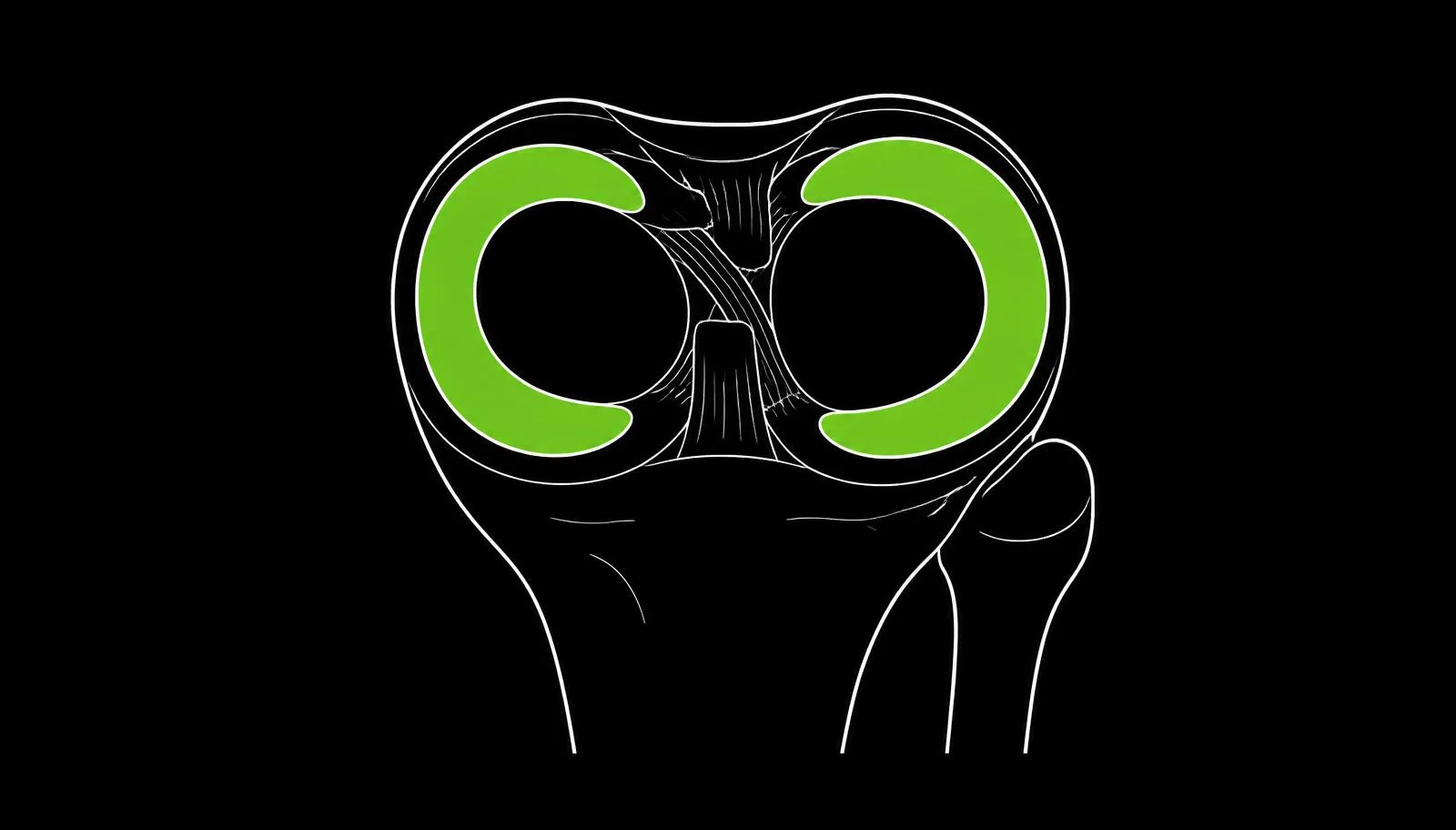
Each knee has two menisci, C-shaped wedges of tough cartilage sitting between the thigh bone and the shin bone, one on the inner side and one on the outer. They spread load across the joint, absorb shock and help the knee stay stable.
They matter more than was once appreciated. A knee that has lost meniscal tissue carries load over a smaller area, which increases wear on the joint surfaces. This is why modern practice preserves as much meniscus as possible rather than simply trimming out the damaged part.
What is articular cartilage?
Articular cartilage is the smooth white surface covering the ends of the bones inside the joint. It allows the knee to glide almost without friction.
Unlike the meniscus, articular cartilage has virtually no blood supply and very limited capacity to heal. Once an area is damaged it does not regenerate on its own. Damage may be a discrete injury in an otherwise healthy knee, or it may be part of generalised wear, which is osteoarthritis. That distinction determines the treatment.
What types of meniscal tear are there?

The distinction that matters most is between traumatic tears and degenerative tears, because they behave differently and respond to different treatment.
Traumatic tears
These occur in a healthy meniscus, usually in younger and more active people, through a twisting injury. They often occur alongside ligament injuries, particularly ACL tears. Symptoms typically include a specific incident, pain on the joint line, swelling over hours, catching, and sometimes locking where the knee will not fully straighten.
Traumatic tears in the outer part of the meniscus, where there is a blood supply, may be repairable.
Degenerative tears
These occur in a meniscus that has already begun to wear, usually in people over forty, often without any clear injury. They are extremely common and frequently found on scans in people with no symptoms at all.
Degenerative tears are usually part of a wider process of wear in the knee rather than an isolated problem. This matters, because removing the torn part does not treat the underlying condition.
Bucket handle and locked knees
A large tear can displace into the joint and block movement, so that the knee will not straighten fully. A locked knee needs urgent assessment, and surgery is usually required, often to repair rather than remove the displaced fragment.
When is surgery needed, and when is it not?
This is the most important section on this page, and it is where practice has changed most in recent years.
Where surgery is usually appropriate
- A locked knee that will not fully straighten
- A repairable traumatic tear, particularly in a younger patient
- A meniscal tear alongside an ACL injury being reconstructed
- A meniscal root tear, where the attachment of the meniscus has pulled off
- A loose fragment of bone or cartilage moving within the joint
- A discrete area of cartilage damage in an otherwise healthy knee
Where surgery is usually not appropriate
For degenerative meniscal tears in middle-aged and older people, particularly where there is arthritis in the knee, the evidence does not support keyhole surgery.
Multiple high-quality randomised trials have compared arthroscopic partial meniscectomy with physiotherapy or with placebo surgery in this group and found no meaningful additional benefit in pain, function or quality of life. Observational research has also linked the procedure to a higher rate of subsequent knee replacement in people with, or at risk of, osteoarthritis.
NICE advises against referral for arthroscopic washout and debridement as part of the treatment of osteoarthritis, unless there is a clear history of the knee mechanically locking.
If your scan shows a degenerative meniscal tear and your knee is painful but not locking, the honest position is that an operation is unlikely to help, and that physiotherapy, load management and time are more likely to. Mr John Lynch will tell you if that applies to you rather than proceeding to surgery that the evidence does not support.
What meniscal procedures are available?

Meniscal repair
Where the tear is in a part of the meniscus with a blood supply, and the tissue is of good quality, it can be stitched back together using sutures or small implants placed arthroscopically. Repair preserves the meniscus and protects the joint long term.
Recovery is longer than after removal, because the repair needs to heal. Weight-bearing and bending are usually restricted for several weeks.
Partial meniscectomy
Where a tear cannot be repaired, the damaged portion is trimmed away, leaving as much healthy meniscus as possible. Recovery is quicker than after repair. Because removing meniscal tissue increases load on the joint surfaces, this is done as conservatively as the tear allows.
Meniscal root repair
The root is where the meniscus anchors to the bone. If it detaches, the meniscus stops functioning altogether, and load across the joint increases sharply. Root tears are often missed. Where identified in a suitable knee, reattaching the root can preserve function.
Meniscal transplantation
In selected cases where the meniscus has been largely removed and the knee is painful as a result, donor meniscal tissue can be transplanted. This is a specialised procedure with specific indications, generally considered in younger patients with an otherwise well-aligned and stable knee.
What cartilage procedures are available?
Treatment of articular cartilage damage depends on the size and depth of the defect, its location, and whether the rest of the joint is healthy.
Debridement
Loose or unstable flaps of cartilage are trimmed to leave a stable edge. This can settle mechanical symptoms such as catching, but it does not restore the cartilage surface.
Microfracture and marrow stimulation
Small holes are made in the exposed bone beneath the defect, allowing cells from the bone marrow to enter and form repair tissue. The tissue that forms is fibrocartilage, which is less durable than the original surface. Best suited to small defects.
Osteochondral transfer
A plug of healthy bone and cartilage is taken from a low-load area of the knee and transferred into the defect. This restores true articular cartilage but is limited by how much donor tissue is available.
Cell-based cartilage repair
Cartilage cells are harvested from the knee, grown in a laboratory, and implanted into the defect at a second operation. This is used for larger defects in younger patients with otherwise healthy knees. Availability and funding vary, and it is not suitable where the knee is arthritic.
What cartilage surgery cannot do
None of these procedures treats established osteoarthritis. They are used for discrete areas of damage in a knee that is otherwise in good condition. Where the wear is widespread, the options are the non-surgical treatments for arthritis, or joint replacement.
What is recovery like?
Recovery varies more on this page than on any other, because these are several different operations. The single biggest factor is whether tissue has been repaired, which needs time to heal, or removed, which does not.
After partial meniscectomy
The quickest recovery of the procedures on this page. Walking is usually possible straight away, often with crutches for a short period for comfort. Swelling settles over a few weeks. Desk work is generally possible within days, and physical work and sport over the following weeks, guided by symptoms.
After meniscal repair
Considerably slower, because the repair must heal. Weight-bearing is often restricted, and a brace is commonly used to limit how far the knee bends for the first few weeks. Crutches are typically needed for longer. Return to pivoting sport takes several months.
After cartilage repair procedures
The slowest recovery. Weight-bearing is usually restricted for a period to protect the repairing surface, and continuous passive movement or specific exercise protocols may be used. Full recovery is measured in months rather than weeks, and the repair tissue continues to mature for a considerable time afterwards.
Mr John Lynch will give you a specific rehabilitation plan for the procedure you have had. Following it matters a great deal, particularly where tissue has been repaired.
What are the risks?
- Infection
- Blood clots in the leg or lungs
- Ongoing pain, swelling or stiffness
- Failure of a meniscal repair to heal, requiring further surgery
- Failure of a cartilage repair to integrate
- Progression of arthritis, which removing meniscal tissue can accelerate
- Damage to nerves or blood vessels
- Numbness around the incisions
- Persistent swelling in the joint
- Risks associated with anaesthesia
Mr John Lynch will discuss the risks specific to the procedure being considered in your case.
What are the alternatives?
Physiotherapy. For degenerative tears and for many cartilage problems, a structured exercise programme is the first-line treatment and is as effective as surgery in the groups that have been studied.
Load management and weight. Reducing load through the knee has a direct effect on symptoms from both meniscal and cartilage problems.
Injections. Steroid injections can settle inflammation and pain. They do not repair tissue, but they can be useful for managing symptoms.
Time. Many degenerative tears become less symptomatic over months without any intervention.
Treating the underlying arthritis. Where the real problem is wear rather than the tear itself, the treatment is that of osteoarthritis, which may eventually include partial or total knee replacement.
What does meniscal and cartilage surgery cost?
These procedures are available on a self-pay basis or through private medical insurance. Costs vary considerably depending on which procedure is required, and cell-based cartilage repair is significantly more expensive than arthroscopic surgery. Please contact us for current fees, to discuss what is included, and to check which insurers are recognised.
Book a consultation
To arrange an appointment, please call us or use the enquiry form.